


Did you always want to be a writer?
What I have always wanted to be is a blues guitarist, but since I remember being turned down for the marching band because I just didn�t hear the notes when I was in junior high, that hasn�t been a possibility. When I was nine, though, I became best friends with a girl a few years older than me who lived across from my grandmother in Hager Hill, in Eastern Kentucky. Her name was Vicky, and she played a twelve-string and wrote poems. I wanted to be her, so I started writing poems. She�s still a good friend, but I don�t write poems any more. I write prose.
What are some of your favorite books and writers? Why?
My favorite books, and their writers, change all the time. When I was in high school, I loved Thomas Hardy. By the time I was in college, I fell in love with D.H. Lawrence. For a long time after that, my favorite novel was A Death in the Family, by James Agee. I named one of my small dogs after the main character in that novel, which was a mistake, since I want to see Rufus the boy in my mind, not Rufus the dog when I reread the book. Leslie Marmon Silko�s Ceremony. Toni Morrison�s The Song of Solomon and Beloved. Lately, because I had been writing non-fiction, I�ve also been reading that genre. Mary Karr�s The Liar�s Club is one of my absolute favorites.
Have you also written fiction and, if so, explain how the process is different for you?
The first longer prose I tried to write was the short story. I remember going to a writers� conference and being assigned Mary Lee Settle as the person who would critique my work. I turned in a positively voluminous story called "The Motel of the Stars." What she said was, "You don�t know it yet, but you�re a novelist." Finally, about ten years later, I finished a novel, Strange Birds in the Tree of Heaven. That satisfied my urge for breadth and depth, but, as with the short story, I still struggled with plot. Writing a story about my own experiences, writing a memoir, has taught me an incredible amount about the way plots work, the events are there already, to be arranged and shaped. I�m finding that, now that I�m working on fiction again, my plots are growing up.
Was there a moment that led you to begin writing non-fiction?
Novelist Lee Smith provided me with the motive for writing my own story. I�d given her a draft of Strange Birds in the Tree of Heaven to read, and she graciously commented. She also read an essay I�d written ABOUT the novel, where my ideas came from, who my family is, what the lives of women in my mother�s family are like. She wrote me back and asked me a question: "Why, in this age of the memoir, haven�t you written your own story?" That question led, eventually, to the memoir itself.
How did you first become interested in the topic of your book and what made you want to write a book about it to tell a particular story?
I first became interested in this memoir�s topic on June 21, 1973, which is the day I relinquished my son, Andrew Cox, to a state-supported adoption. It took me 28 years to have the courage to tell the story of that part of my life.
How long did research for this book take and did you know at the beginning that it would take the direction that it did?
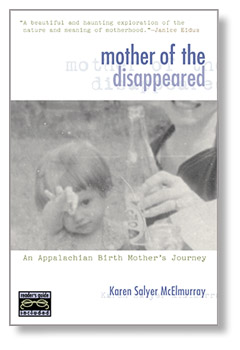
My research for Mother of the Disappeared was varied. I read a lot about the life and times, as we know them, of the Virgin Mary. I put up every photograph I could find from my childhood on my studio walls. But my main source of research, I�d have to say, has been the courage to take a long, hard look at my own heart. What I learned, and the direction the story took, have both been amazing for me. I�d finished writing the memoir in October of 2000, and the publication date was pushed back, which I found very frustrating. Then, in November of 2001, while I was still waiting for my book to step out on its own and get a publication life, my birth son�s fianc� found me over the internet. I met him in January of 2002. What did I learn? I learned that writing has a power that equals and surpasses the power of getting the book out there in the sense of publishing, in the sense of that sometimes artificial world. Art is, as painter Robert Motherwell has said, one of the few remaining guardians of the human spirit that we have.
Were there any surprises when you were researching this book?
Surprises? A 28 year old young man named Andrew George Cox, who just happened to be my birth son was an incredible surprise.
What about the topic of your book do you want readers to come away understanding?
I have believed that the telling of my story as a birth mother is a kind of "coming out," a giving voice to an experience that many families, particularly many women, have had, an experience that is not discussed. The relinquishment of a child to adoption, as the film called Secrets and Lies so aptly describes, is one of shame, secrecy, and often unbearable and unspoken loss. I hope this memoir will bring healing to other mothers and that it will bring other children back into their mothers� lives.
If you could only choose one book to read over and over for the rest of your life, which book would you choose?
Well, if I were going to read one book over and over again, I suppose it would be Ceremony, again by Leslie Marmon Silko. I�ve taught that novel five times now, and have read it probably ten times. Each reading, I learn more and more about a complex, non-linear narrative structure. I learn something new about Tayo, the central character. And most of all, I learn, again and again, as she describes in that novel, that stories have spiritual power.
From your perspective, what has been your greatest accomplishment in life so far?
My greatest accomplishment in life has been the discovery, at age 45, that I have the right and the ability to be happy.
Are you working on anything new and, if so, what can you tell us about it?
I�m working on a new novel that is partly about the second anniversary of The Harmonic Convergence. It�s also a story about love. That�s all I can say, for now, because the book is still being born.